Battery Terminal Replacement 2026: Top Post vs Side Post
Battery terminal replacement in 2026: how to match top-post, side-post and GM stud fitments, size cable gauge correctly, and which clamp kits are worth buying.
Reader-supported: we may earn a commission from links on this page, at no extra cost to you. It never affects our picks. Learn more.
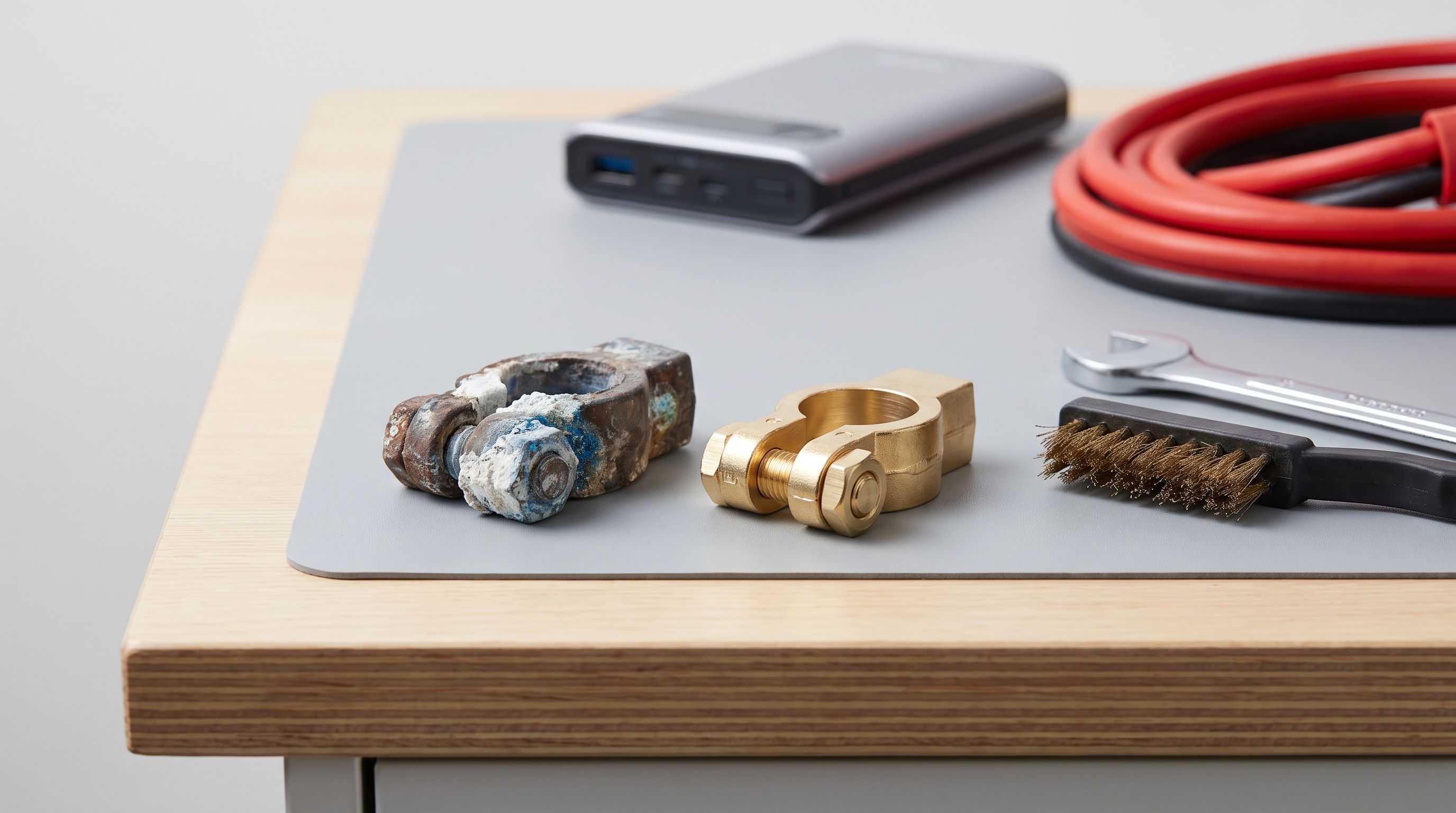
Corroded battery terminals cause problems that look far more expensive than they are: a no-crank morning, a flickering dash, an alternator that never quite tops the battery up, or a car that dies the moment you hit a pothole. The fix is usually a few dollars of lead and twenty minutes of work — but only if you buy the right terminal for your battery's post style.
That's where most people get stuck. "Battery terminal" is not one part. There are top-post clamps, GM-style side-post bolts, stud-type marine posts, and dual-purpose hybrid batteries that accept both. Get it wrong and you'll be standing in the driveway with a part that physically cannot attach to your battery.
This guide explains how to identify your post type, how to size a replacement to your cable gauge, and which replacement terminals and tools are worth buying in 2026. We researched manufacturer specs, SAE post dimensions, and verified owner feedback to make these picks — we don't physically test units.
The short version
- Best overall: Ampper Military Spec Battery Terminal Kit
- Best corrosion fix: NOCO GCP1 Battery Terminal Protectors
- Budget pick: Sparkfix Battery Terminal Connectors
- Best for GM side-post: ACDelco Professional 2SS1 Side Terminal Battery Cable Adapter
- Best removal tool: Performance Tool W1264 Battery Terminal Puller
 Best overall · Ampper Military Spec Battery Terminal Kit — Check price on Amazon →
First: identify your post style
Pop the hood and look at where the cables attach to the battery. One of these four will be true.
Top post (SAE tapered)
The classic. Two tapered lead posts rise from the top of the battery, and the cable clamps wrap around them and pinch closed with a bolt. This is the most common automotive layout worldwide and the one virtually all universal replacement clamps are designed for.
Critically, the positive and negative posts are different diameters. SAE spec puts the positive post at roughly 17.5 mm across the top and the negative at roughly 15.9 mm, both with a slight taper. That's why terminals are sold in positive/negative pairs and usually color coded red and black. A negative clamp will not close properly on a positive post, and a positive clamp on a negative post will never grip tightly no matter how hard you crank the bolt — it'll feel snug, then go loose a week later.
Side post (GM style)
Common on GM vehicles from the late 1970s onward and still found on plenty of Chevy, Buick, GMC and Cadillac models. Instead of posts on top, there are two recessed threaded holes on the side of the case, and the cable terminal bolts in with a 3/8"-16 bolt. These corrode in a sneaky way: the damage happens inside the recess where you can't see it, and the symptom is intermittent cranking.
Side-post repair has two paths. Either replace the whole side-terminal cable end, or install an adapter that converts the side terminal into a conventional stud — which is what the ACDelco Professional 2SS1 Side Terminal Battery Cable Adapter does.
Stud / military-spec post
Found on marine batteries, many AGM and lithium batteries, commercial equipment, and increasingly on aftermarket performance batteries. The post is a threaded stud (commonly 3/8" or 5/16") and the cable terminates in a ring lug secured by a nut. It's the most secure connection of the three and the easiest to add accessory circuits to.
Many "military spec" terminal kits, including the Ampper Military Spec Battery Terminal Kit, clamp onto a standard SAE top post and convert it to a stud output. That's a genuinely useful upgrade if you run a winch, dual battery setup, inverter or amplifier.
Dual-post / hybrid
Some batteries — particularly GM applications — carry both top posts and side terminals. You get to choose. If both are available and your existing cable reaches comfortably, top post is usually easier to service.
Fitment caution: post style is a property of the battery, not just the vehicle. A previous owner may have fitted a different group size. Always look at the battery in front of you before ordering, and confirm the replacement's listed post type and cable gauge range.
Sizing the cable gauge correctly
A universal terminal has a cable clamp area rated for a gauge range — typically something like 2–6 AWG for the main cable, with smaller auxiliary ports for accessory wires. Two failure modes:
- Cable too small for the clamp: the conductor doesn't get compressed evenly, resistance rises, the joint heats, and eventually the terminal melts or the strands anneal. Don't fill the gap with random bits of wire.
- Cable too large: you'll shave strands off to make it fit. Every strand you cut is capacity you've removed from a circuit carrying several hundred amps at crank.
Typical starter cable on a four- or six-cylinder passenger car is 4 AWG or 6 AWG. V8s, diesels and vehicles with long cable runs commonly use 2 AWG or 1/0. Always match the terminal to the cable you actually have — measure the copper, not the insulation, because thick jacketing makes a 6 AWG cable look like a 2 AWG one.
If you're adding accessory circuits, remember that a terminal's auxiliary stud is a convenient distribution point but not a fuse. Any accessory wire leaving the battery needs its own fuse or breaker within a few inches of the terminal.
Comparison table
| Product | Best for | Post type | Material / build | Main trade-off |
|---|---|---|---|---|
| Ampper Military Spec Battery Terminal Kit | Accessory-heavy builds, dual battery, marine | Clamps SAE top post, outputs threaded studs | Heavy marine-grade construction, multiple outputs | Bulkier than a plain clamp; may fight tight hold-downs |
| NOCO GCP1 Battery Terminal Protectors | Stopping repeat corrosion | Top post (universal) | Treated felt washers | Not a terminal — pair with new clamps |
| Sparkfix Battery Terminal Connectors | Fast, cheap replacement of rotted clamps | Top post, positive + negative pair | Lead/alloy clamps, color coded, bolt-down cable clamp | Entry-level hardware; check bolt torque after a week |
| ACDelco Professional 2SS1 | GM side-post vehicles | Side post, 3/8"-16 | OE-grade adapter, converts to stud | Adds height/width — check clearance to inner fender |
| Performance Tool W1264 | Removing a seized clamp | Top post | Steel puller | A tool, not a part; one-job purchase |
The picks
Ampper Military Spec Battery Terminal Kit — best overall
Prices last checked October 18, 2026. Amazon prices change frequently, so treat these as a guide and check the live price before you buy.
Ampper Military Spec Battery Terminal Kit
Marine-grade military-spec posts with multiple stud outputs — the most versatile top-post upgrade.
This is the pick if your battery job is really a wiring job. The Ampper kit clamps onto standard SAE top posts and converts them into threaded stud posts with multiple output positions, so you can land the main starter cable plus ring-lugged accessory feeds without stacking five clamps on one post. Owner feedback consistently praises the clamping force and the fact that connections stay tight over time — a common failure point with thin stamped clamps.
Who it suits: trucks with winches, overland builds, dual-battery systems, car audio, marine. What it gives up: bulk. These sit taller and wider than a stock clamp, so check hood and battery cover clearance before you commit. It's also overkill for a stock commuter car that just needs a clean connection.
NOCO GCP1 Battery Terminal Protectors — best corrosion fix
NOCO GCP1 Battery Terminal Protectors
Felt anti-corrosion washers that stop the fuzzy green growth from coming straight back.
These treated felt washers slip over the posts beneath the terminals, where they absorb and neutralize the acidic vapor that creates the fluffy white-and-green growth. If you've replaced terminals before and watched the corrosion return within months, this is the missing step — corrosion is usually a venting problem, not a cleanliness problem.
They're not a replacement terminal, so they belong in the cart alongside new clamps rather than instead of them. Install them clean: wire-brush the post and clamp to bright metal first, seat the washer flat, then torque the clamp. They're inexpensive, take thirty seconds, and genuinely extend the life of the repair. The trade-off is simply that they can't fix an already-pitted or undersized clamp.
Sparkfix Battery Terminal Connectors — budget pick
Sparkfix Battery Terminal Connectors
Inexpensive color-coded lead clamps with bolt-down cable clamps for a quick roadside repair.
Sold as a positive/negative pair, color coded, with bolt-down cable clamps rather than crimp-only barrels — which matters because it means you can fit them with hand tools at the roadside, no hydraulic crimper required. For the very common scenario of a factory clamp that's cracked, stretched or eaten away by acid, this is the straightforward fix.
Expect entry-level hardware. The bolts and clamp plates aren't as beefy as premium brass or military-spec units, so check the torque after a week of heat cycles and again a month later. Pair them with anti-corrosion washers and a dab of dielectric grease on the outside of the joint. For a stock vehicle with no accessory load, they do the job.
ACDelco Professional 2SS1 — best for GM side-post
ACDelco Professional 2SS1 Side Terminal Battery Cable Adapter
OE-style side-post adapter that converts a GM side terminal to a standard stud output.
Side-post batteries are their own ecosystem, and most "universal" terminal kits simply don't fit them. The ACDelco Professional 2SS1 is a side-terminal adapter that threads into the battery's 3/8"-16 side terminal and gives you a conventional stud to land cables or ring terminals on — useful both for repairing a corroded side terminal and for adding accessories to a GM vehicle.
Verify fitment against your specific year and model, and check clearance: side-post batteries often sit close to an inner fender or airbox, and adding an adapter plus a cable eye pushes outward. Also watch bolt length — too long and it bottoms in the battery; too short and you get a weak, heat-generating connection.
Performance Tool W1264 — best removal tool
Performance Tool W1264 Battery Terminal Puller
Pulls a seized clamp off the post without hammering, prying or cracking the battery case.
The hidden hazard in battery terminal replacement is removal. A clamp that's been on a post for eight years will not simply lift off, and the two things people reach for — a screwdriver as a pry bar, or a hammer — are exactly what cracks the battery case or shears the post off internally. That turns a cheap repair into a new battery.
The W1264 is a simple screw-type puller that sits over the clamp and lifts it straight up with steady force. It's a one-job tool, and if you only ever do this once, you may be able to borrow one from a parts store loaner program. But if you maintain several vehicles, it pays for itself the first time it saves a battery.
How to choose
Match the post type before anything else
Top post, side post, or stud. Look at the battery, not the vehicle listing. If your battery has both top posts and side terminals, you can use either — pick whichever gives the cables a natural, unstressed route.
Match the clamp to your cable gauge
Check the terminal's stated AWG range and compare it to the actual copper in your cable. A clamp that's too large or too small produces a high-resistance joint that heats, and heat is what kills battery cables. Don't shave strands to force a fit.
Decide between lead, brass, and military-spec
Cast lead clamps are inexpensive, conform well to the post and are what most factories use. Brass and military-spec terminals offer better conductivity, stronger clamping and multiple accessory outputs, but cost more and take up more space. If you're running only a starter and the stock harness, lead is fine. If you're adding loads, go military-spec.
Think about clearance and cable length
Taller terminals, adapters and stud conversions all change geometry. Before ordering, check how much room is between the battery top and the hood, cover, or inner fender — and confirm the existing cables still reach without being pulled tight. A cable under tension will eventually loosen or crack a terminal.
Plan for corrosion from day one
Clean posts to bright metal, fit anti-corrosion felt washers, torque properly, then apply grease or a terminal protectant to the outside of the joint only — never between the clamp and post, where it would act as an insulator.
FAQ
How do I know if my battery terminals need replacing, or just cleaning? Clean them first. If the clamp is cracked, stretched so it no longer pinches tight, badly pitted under the corrosion, or if the bolt threads strip, replace it. A clamp you can rotate on the post by hand after tightening is done.
Which terminal do I disconnect first? Negative first, positive last, when removing. Reverse on reassembly: positive first, then negative. This minimizes the chance of a wrench touching the positive post and a grounded surface simultaneously.
Are positive and negative top-post terminals interchangeable? No. SAE positive posts are slightly larger in diameter than negative. Use the matched pair; the color coding reflects a real dimensional difference, not just a labeling convention.
Can I use a top-post terminal on a side-post battery? Not directly. You either need a side-terminal cable end, or a side-post-to-stud adapter like the ACDelco Professional 2SS1. Some batteries are dual-post and accept both styles.
Do I need to crimp, or is a bolt-down clamp acceptable? A properly crimped-and-sealed lug is the most durable connection. Bolt-down universal clamps are a legitimate repair and are far easier to do without special tools — just check torque after a few heat cycles and keep the joint sealed against moisture.
Will new terminals fix a car that won't start? Sometimes, if corrosion was the cause. But new terminals won't revive a battery that's genuinely failed. Before buying parts, have the battery and charging system load-tested — most auto parts stores do it free.
Get the best car care deals in your inbox
Join the GarageProof newsletter for hand-picked car care deals and new buying guides. No spam, unsubscribe anytime.
Related reads
Jump Starter Clamps in 2026: Will They Fit Your Posts?
Jump starter clamps vs battery terminals: compare jaw openings, cable gauge and reach for top-post, side-post and recessed truck batteries before you buy in 2026.
Prime Big Deal Days: What to Look For in Jump Starters
Prime Big Deal Days runs October 6-7, 2026. Here's which jump starter and tire inflator specs actually decide the purchase — and the cold-weather sizing mistake to avoid.
Car Window Breaker Escape Tool 2026: Spring vs Hammer
Spring-loaded punches fail on laminated side glass. Compare car window breaker escape tools for 2026 and learn which windows in your car can actually be broken.