12V Air Compressor for Truck Tires in 2026: 4 That Handle 80 PSI
Need a 12V air compressor for truck tires or RV duals? We compare duty cycle, max PSI and clamp vs socket power so your roadside kit can actually reach 80–110 PSI.
Reader-supported: we may earn a commission from links on this page, at no extra cost to you. It never affects our picks. Learn more.
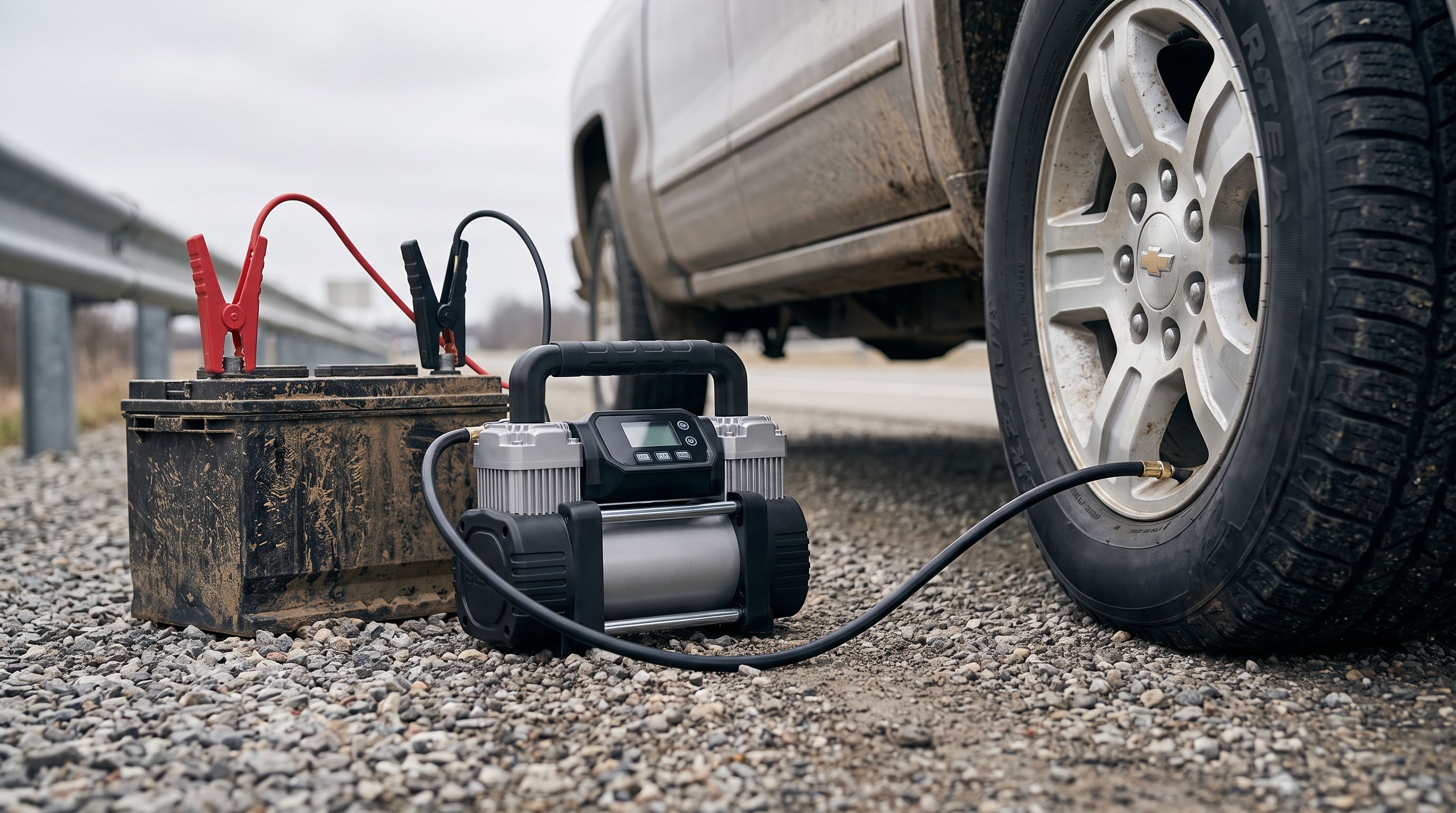
If your emergency kit was built around a tire inflator that plugs into the cigarette lighter, there's a decent chance it can't do the one job you bought it for. A 12V socket is typically fused at 10–15 amps. A compressor capable of pushing a light-truck tire to 80 PSI — never mind an RV tire at 100–110 PSI — can draw 20–30 amps. The math doesn't work, and the compressor either blows the fuse or thermally shuts down halfway through.
This guide is about the other category: clamp-fed 12V compressors with real duty cycle ratings, sized for LT-metric truck tires, 35-inch off-road tires, and RV/trailer tires that live well above passenger-car pressures. We compared published specs, independent reviews and long-term owner feedback to rank the ones worth putting in the bed box.
The short version
- Best overall: VIAIR 400P-Automatic
- Premium pick: ARB CKMP12 Portable Air Compressor
- Budget pick: VIAIR 88P
- Best for fast multi-tire inflation: ALL-TOP 12V Portable Air Compressor
- Best compact backup: Avid Power Pistol Grip Tire Inflator
 Best compact backup · Avid Power Pistol Grip Tire Inflator — Check price on Amazon →
 Budget pick · VIAIR 88P — Check price on Amazon →
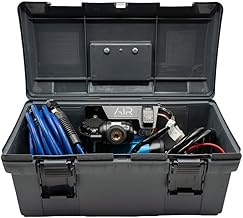 Premium pick · ARB CKMP12 Portable Air Compressor — Check price on Amazon →
 Best overall · VIAIR 400P-Automatic — Check price on Amazon →
Why truck and RV tires change the math
A 225/65R17 passenger tire runs around 35 PSI and holds a small volume of air. An LT275/70R18 at 65–80 PSI holds far more air at far higher pressure, and an RV tire on a Class C or a fifth-wheel can spec 100–110 PSI cold. Three things get harder as pressure and volume climb:
Current draw rises with pressure. A compressor's amp draw is lowest at the start of a fill and highest near its cutoff pressure. That's precisely when a 15A socket circuit gives up. Direct-to-battery clamps sidestep the problem entirely.
Heat becomes the limiting factor. Air compression generates heat, and small 12V units have minimal cooling. Duty cycle — the share of a given period a compressor can run before it needs to rest — is the spec that tells you whether it will finish the job. A unit with no published duty cycle is usually hiding one.
Fill time compounds. One flat tire is an inconvenience. Airing up four tires after a beach run, or four RV tires plus a spare, is a 20–40 minute job with a mid-size compressor and an hour-plus with a small one, assuming it doesn't shut down.
How to choose
Match max PSI to your door placard, with headroom
Buy a compressor whose maximum rated pressure clears your highest cold inflation pressure by a comfortable margin. Compressors slow dramatically as they approach their ceiling, so a 100 PSI-max unit filling a 100 PSI RV tire is a bad experience. For LT truck tires at 65–80 PSI, a 120–150 PSI unit is right. For RV, dually or trailer tires at 100–110 PSI, treat 150 PSI as the practical minimum, and look for compressors that explicitly advertise a heavy-vehicle or high-pressure mode. Check your driver's door jamb placard and, for an RV, the tire-and-loading label — motorhome pressures are often set by axle weight, not by the tire's max sidewall rating.
Clamp vs. socket: the single most important decision
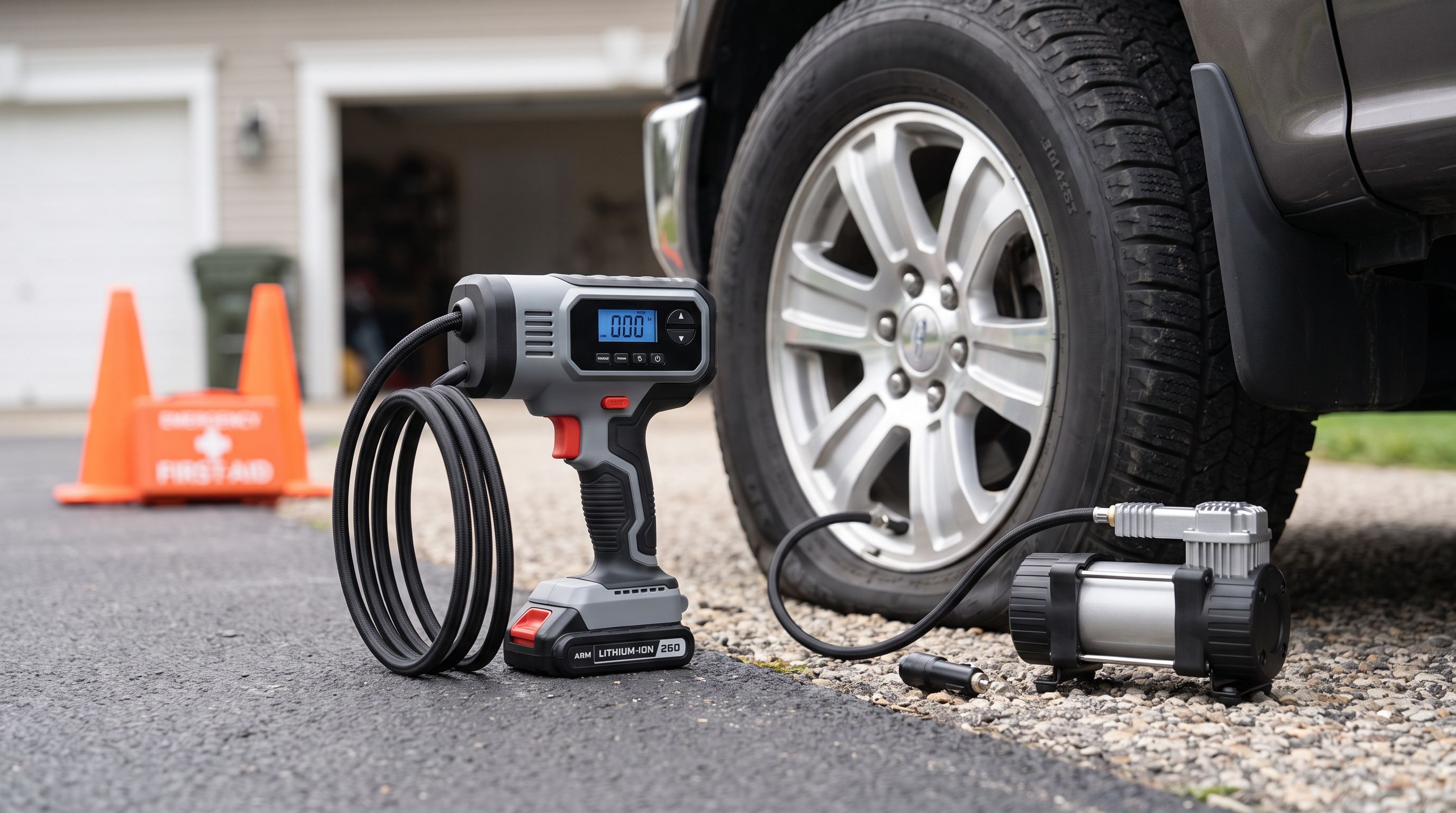
Battery clamps let a compressor draw the 20–30+ amps it needs without worrying about an accessory fuse. Socket-powered units are capped by the circuit and are realistically limited to topping off, bicycle tires and small passenger tires. Some units ship both ways or offer an adapter — if you tow, haul, or run anything bigger than a half-ton's stock tire, clamps are the answer. A handful of serious users hardwire a dedicated circuit with an Anderson connector in the bed or under the hood; it's a cheap upgrade and makes airing up far less of a chore.
Read duty cycle, not just CFM
Manufacturers love to advertise free-flow CFM, which is measured at zero back pressure and bears little relation to how fast a tire fills. The more useful pairing is CFM at pressure (say, at 30 or 40 PSI) plus a duty cycle stated at a specific pressure and ambient temperature. VIAIR, for example, publishes duty cycle at 100 PSI; that's the kind of spec you can plan around. If you regularly air up a full set, favor a dual-cylinder or higher-displacement unit — the cooldown breaks are what really stretch out the job.
Hose, fittings and the stuff that actually fails
For duallies and RVs, hose length and chuck design matter as much as the motor. You need enough hose to reach inner duals and rear RV valves without moving the vehicle, and ideally a dual-foot or extended chuck for recessed valve stems. Screw-on chucks hold position and don't leak like cheap lever clamps. Inline gauges on budget units are frequently off by several PSI — keep a separate dial or digital gauge in the kit and verify. Also check that the power leads are long enough to reach the battery from the farthest tire; short cables are a common complaint.
Storage, noise and realism
These are not quiet tools, and they're not small. A VIAIR 400P-class unit in its bag takes up meaningful space in a truck box or RV bay. Decide now whether you want a permanently mounted onboard system (plumbed, with a tank) or a portable kit, because the portable units get used far more often simply because they're easy to grab.
Comparison table
| Model | Power connection | Max pressure | Best suited to | Notable limitation |
|---|---|---|---|---|
| VIAIR 400P-Automatic | Battery clamps | 150 PSI | LT truck, 35s, RV tires | Bulky; loud at pressure |
| ARB CKMP12 | Battery clamps | High-pressure rated for 4x4 use | Overland, towing, trail airing-up | Premium price for the capability |
| VIAIR 88P | Battery clamps | 120 PSI | Half-ton and LT tires, occasional use | Slower; lower duty cycle than 400-series |
| ALL-TOP 12V dual cylinder | Battery clamps | High-pressure rated | Airing up four large tires quickly | Large, heavy, needs storage space |
| Avid Power Pistol Grip | 12V socket | Lower-pressure class | Top-offs, passenger tires, bikes | Not suitable for filling flat LT/RV tires |
The picks
VIAIR 400P-Automatic — best overall
Prices last checked October 26, 2026. Amazon prices change frequently, so treat these as a guide and check the live price before you buy.
VIAIR 400P-Automatic
150 PSI max, clamp-fed, with a 33% duty cycle at 100 PSI — the sweet spot for LT and RV tires.
This is the default recommendation for a reason. The 400P-Automatic is clamp-fed, rated to 150 PSI, and VIAIR publishes a real duty cycle at 100 PSI rather than vague marketing numbers — which is exactly what you want when a motorhome tire needs to reach 105. The "Automatic" variant adds a pressure switch so it shuts off at your target instead of requiring you to babysit the gauge, a genuinely useful feature when you're on your knees at an inner dual. Owner feedback is consistently strong on longevity.
What it gives up: it's big, it's heavy, and it's loud under load. The included carry bag eats real storage space, and the sand tray/mounting feet make it awkward in a cramped RV bay.
ARB CKMP12 — premium pick
ARB CKMP12 Portable Air Compressor
Sealed, rugged ARB build with a tough case and strong real-world airflow for trail and tow rigs.
ARB's portable compressor is the one that keeps showing up in independent 2026 inflator roundups as the rugged, trail-ready choice, and the appeal is mostly about build quality. The sealed motor assembly, hard case and ARB's long track record in 4x4 air systems mean it tolerates dust, water spray and repeated use better than most. For overlanders who air down for sand or rock and air back up at the highway, the CKMP12 is a buy-once tool, and ARB's accessory ecosystem — tire deflators, inflation manifolds, hoses — plugs straight in.
What it gives up: price. If you air up twice a year, you're paying for durability you won't use. It's also not the fastest unit per dollar compared with big dual-cylinder options.
VIAIR 88P — budget pick
VIAIR 88P
120 PSI clamp-powered compressor that handles LT tires without the price of a 400-series unit.
The 88P is the sensible entry point into clamp-powered compressors. Rated to 120 PSI, it clears the 65–80 PSI range most LT truck tires live in with room to spare, and it uses the same battery-clamp approach as its bigger siblings instead of relying on a 15A socket. For a half-ton or three-quarter-ton truck owner who wants a compressor for the occasional flat, a seasonal pressure adjustment, or a trailer tire, it's enough compressor without the bulk.
What it gives up: speed and stamina. Duty cycle is lower than the 400-series, so airing up four big tires means waiting through cooldowns. It's also marginal for RV tires that spec 100 PSI or more — the fill slows noticeably near its ceiling.
ALL-TOP 12V Portable Air Compressor — best for fast multi-tire inflation
ALL-TOP 12V Portable Air Compressor
Dual-cylinder, high-CFM design built to air up four 35s or a set of RV tires without long cooldowns.
When the job is four 35-inch tires after a day on the dunes, or a full set on a fifth-wheel, displacement wins. ALL-TOP's dual-cylinder portable units are built around exactly that use case: high airflow, clamp power, and a heavy-vehicle pressure range, with hoses long enough to reach multiple corners. Reviewers routinely compare it directly against ARB's compressors on fill speed, and it's a strong value in that matchup. Dual outlets on some configurations let you run two tires at once with a manifold.
What it gives up: size and weight. This is a two-hands-to-lift tool that needs a dedicated storage spot. Fit and finish is a step below ARB's.
Avid Power Pistol Grip — best compact backup
Avid Power Pistol Grip Tire Inflator
Cheap, small, and fine for topping off — just don't ask it to fill an empty 80 PSI tire.
Not every inflation job needs 30 amps. The Avid Power pistol-grip inflator is the one to keep in the cab for the stuff that happens weekly: a tire down 5 PSI on a cold morning, a trailer tire that needs checking, a bike or sports ball. It's a 12V socket unit with a preset-and-walk-away shutoff, and it earns its spot in 2026 roundups as a cheap, convenient secondary.
What it gives up: everything that matters for a genuinely flat truck tire. Don't expect it to take an LT tire from zero to 80 PSI, and don't expect it to run long enough to do a set. Treat it as a complement to a clamp-fed compressor, not a replacement.
Build the kit around the compressor
A compressor alone doesn't get you back on the road. Add an accurate dial or digital gauge rated past your highest pressure, a tire plug kit (the rope-style kits work on tread punctures, not sidewalls), a pair of nitrile gloves, and a dual-foot chuck if you run duals. For RVs, confirm your valve extensions aren't leaking — they're the most common reason a "flat" RV tire isn't actually punctured. And store the compressor where you can reach it with a loaded bed or a packed bay, not under everything else.
FAQ
Can a cigarette-lighter inflator fill an 80 PSI truck tire? Usually not from flat. The circuit is typically fused at 10–15A, and high-pressure compressors draw more than that near cutoff. Socket-powered inflators are fine for topping off a few PSI; for filling a flat LT or RV tire, use a clamp-fed unit.
What max PSI do I need for RV tires? Check the tire-and-loading label and your tires' cold inflation requirement for your actual axle weights — many RV tires run 95–110 PSI. Choose a compressor rated to at least 150 PSI so you're not filling at the very top of its range, where it slows to a crawl.
What's a good duty cycle for airing up four tires? Look for a stated duty cycle at a real pressure (e.g., 33% at 100 PSI) rather than an unqualified claim. In practice, higher-displacement and dual-cylinder units finish a set with fewer forced cooldowns, which matters more than peak PSI once you clear your target pressure.
Is an onboard compressor better than a portable one? An onboard system with a tank is faster and always available, and it can run air tools. A portable unit is cheaper, moves between vehicles, and — importantly — doesn't require installation. For most truck and RV owners, a good portable compressor is the higher-value choice.
Does my vehicle's year, make and model affect what I buy? Not for the compressor itself, since these are universal 12V tools. But your required pressures, valve stem type, and whether you have duals absolutely vary — check the door jamb placard (or RV loading label) and confirm hose length and chuck style will reach your valves before you buy.
Get the best car care deals in your inbox
Join the GarageProof newsletter for hand-picked car care deals and new buying guides. No spam, unsubscribe anytime.
Related reads
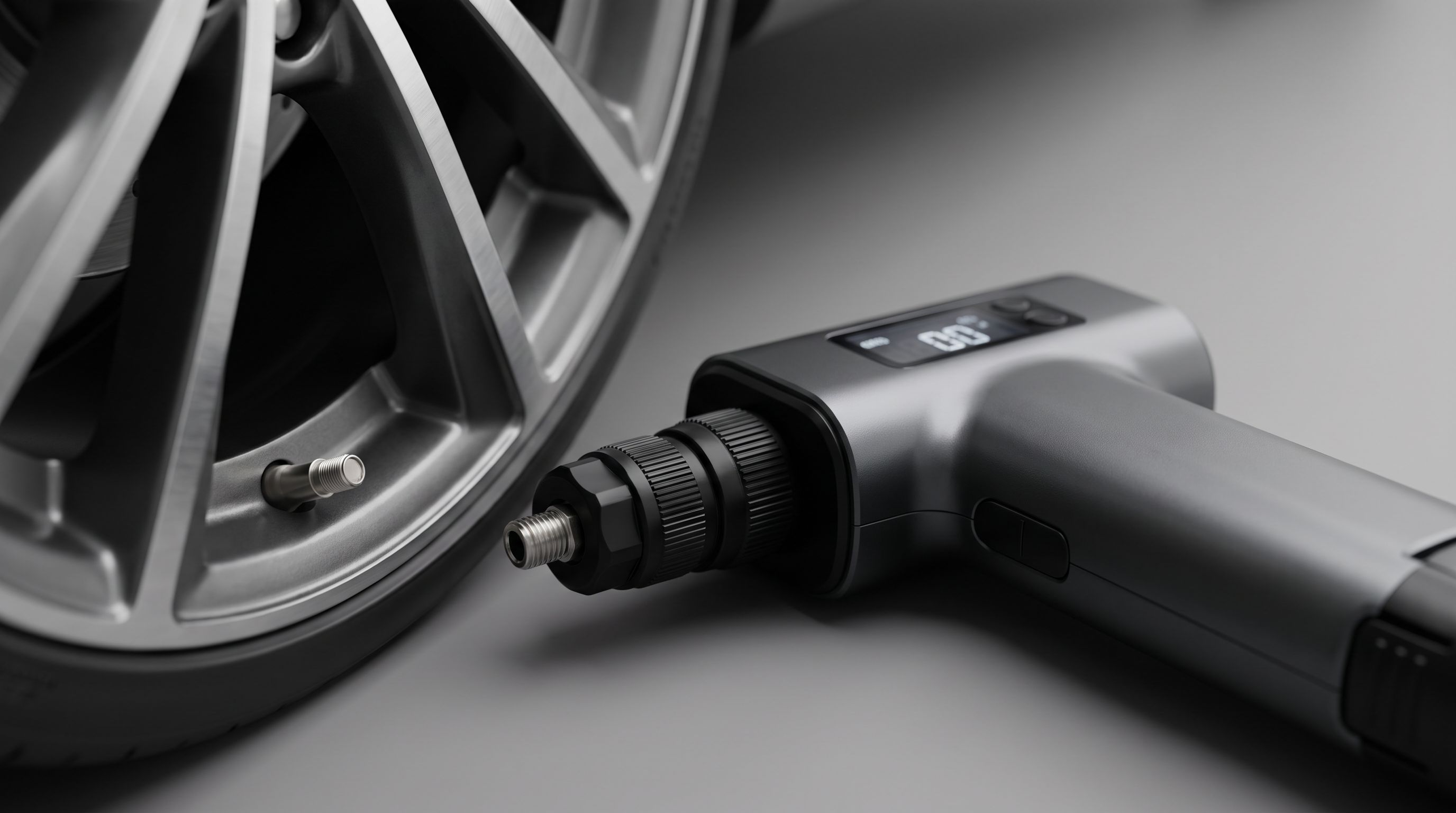
Cordless Tire Inflator Valve Stem Fitment in 2026: 4 Picks
Match cordless tire inflator chucks and hose lengths to your valve stems — rubber, metal, TPMS or recessed alloys — with 2026 picks, specs and owner feedback.
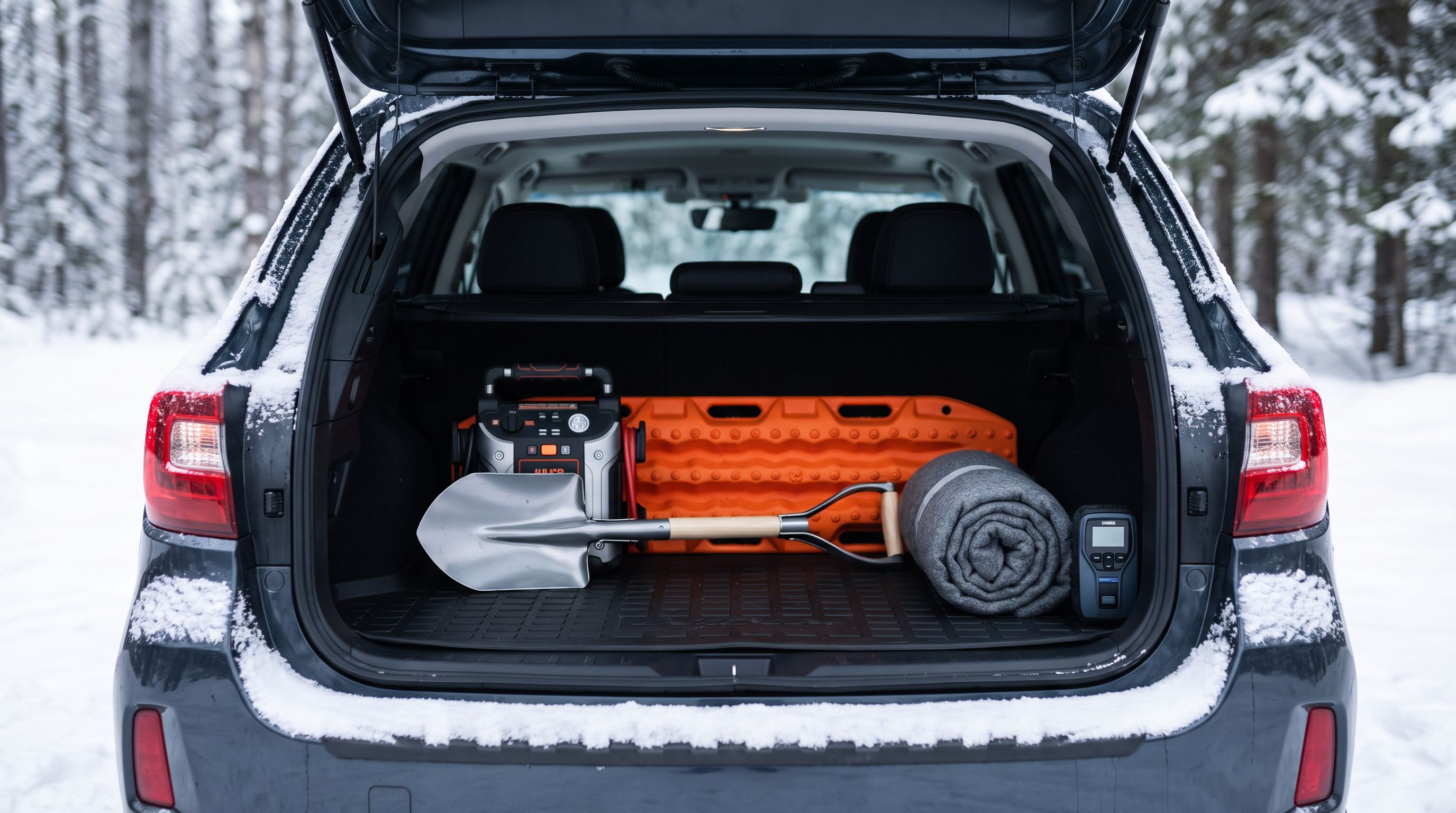
Winter Car Emergency Kit 2026: Build It or Buy It?
Prebuilt winter car emergency kit vs. a component build in 2026: what boxed kits leave out, what a jump starter, inflator and traction boards really cover.
Portable Tire Inflators in 2026: Cordless vs 12V Socket
Cordless lithium or 12V socket? We compare the best portable tire inflator options for 2026 on duty cycle, real fill times for truck and car tires, and gauge accuracy.